Describe the Three Steps of Pcr
Polymerase Chain Reaction PCR is an in vitro method used for selective amplification defined target DNA sequences present within the source of DNA. The melding of a technique for repeated rounds of DNA synthesis with the discovery of a thermostable DNA polymerase has given scientists the very powerful technique known as polymerase chain reaction PCR.

Freebie For Biology Teachers This Short And Sweet Fill In The Blank Flow Char Photosynthesis Photosynthesis And Cellular Respiration Photosynthesis Activities
Annealing of primer to each strand is carried out at 45C-55C.

. Heated briefly to separate DNA strands. Polymerase Chain Reaction PCR can best be describes as a procedure to amplify or make copies of DNA fragments. 2 annealing in which short DNA molecules called primers bind to flanking regions of the target DNA.
First week only 499. Polymerase chain reaction PCR is a laboratory procedure that can create replicas of DNA. The first cycle does not yield the precise length target DNA sequence the first cycle yields larger.
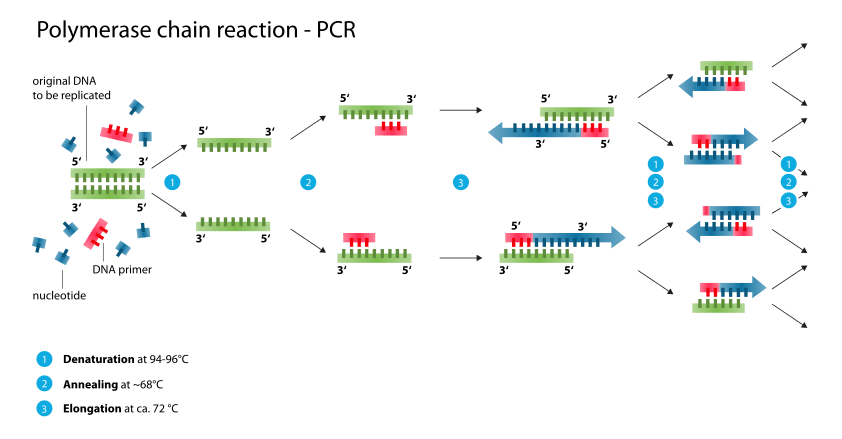
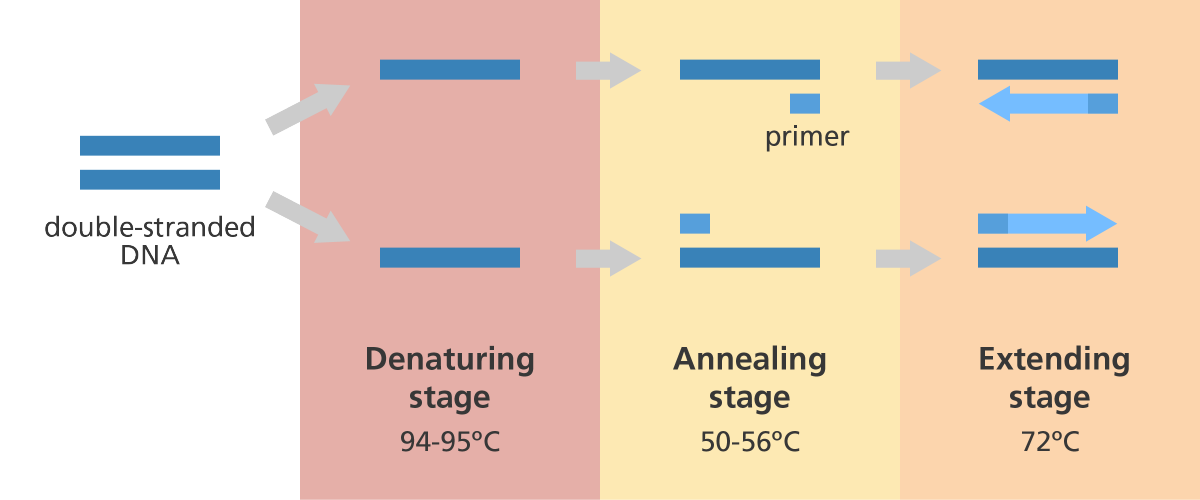
Up to 256 cash back Describe the 3 main steps of each cycle of PCR amplification and what reactions occur at each temperature. Steps of Polymerase Chain Reactions PCR Denaturation strand separation. 3 basic PCR steps include.
This step is generaly carried out at 92C-96C for 2 minutes. The three main steps of PCR amplification are. PCR is based on three simple steps required for any DNA synthesis reaction.
Tap card to see definition. Click again to see term. The cycles are done on an automated cycler a device which rapidly heats and cools the test tubes containing the reaction mixture.
At this step the temperature is. Each of these steps requires a different temperature range which allows PCR machines to control the steps. Describe the three main steps of Polymerase Chain Reaction PCR.
This step involves the binding of primers short lengths of DNA about 20 bp long to the 3. 1 denaturation in which double-stranded DNA templates are heated to separate the strands. Terms in this set 3 Step 1.
Cools to allow primers to hydrogen-bond. Polymerase Chain Reaction PCR has three major steps. The reaction temperature is lowered to 54-60 for around 20-40 seconds.
The PCR cycle has following three steps. Two strand of DNA separates melt down to form single stranded DNA. Click card to see definition.
The separation of the two hydrogen-bonded complementary chains of DNA into a pair of single-stranded polynucleotide molecules by a process of heating 94C to 96C. To amplify a segment of DNA using PCR the sample is first heated so the DNA denatures or separates into two pieces of single-stranded DNA. Tap card to see definition.
In this step the two complementary strands of DNA are seperated by the usage. Each step -- denatauration alteration of structure annealing joining and extension -- takes place at a different temperature. One cycle of Polymerase Chain Reaction involves three basic steps.
These three steps are repeated for 30 or 40 cycles. DNA denaturation primer annealing and extension. In this step the two strands of double-stranded DNA are separated by heating to 94C for 2 minutes.
Double-stranded DNA is separated into two single strands by a process called denaturation which occurs at temperatures higher than 90 degrees Celsius. Three main steps of PCR are 1. The desired DNA is heated to a high temperature of about 91C and forms a single-stranded DNA.
And 3 extension in. Want to see the step-by-step answer. Amplification is achieved by a series of three steps.
This method was designed by Kerry Mullis in 1985. Start your trial now. Check out a sample QA here.
Tap again to see term. DNA Polymerase adds nucleotides to the 3 end of each. It may help to draw it out.
Precise length double-stranded DNA is not formed until cycle 3. PCR is a biochemical process capable of amplifying a single DNA molecule into millions of copies in a short time. PCR polymerase chain reaction is a technique through which a DNA segment is copied to a million fol.
Denaturation 2 View the full answer. A polymerase chain reaction or PCR consists of three steps. Describe the three main steps of Polymerase Chain Reaction PCR.
Explore the three steps of this revolutionary process. Next an enzyme called Taq polymerase synthesizes - builds - two new strands of DNA. PCR consists of the four following steps.
Denaturation occurs when the reaction mixture is heated to 94 for about 05 to 2 minutes. Here the primers bind to their. Describe the three main steps of Polymerase Chain Reaction PCR.
These steps are repeated between 20 and 35 times to synthesize the correct quantity of the DNA of interest. The basic steps involved for PCR are. Heat breaks hydrogen bonds between the base pairs while the stronger bonds between deoxyribose and phosphates remain intact.
PCR consists of three basic steps.
Polymerase Chain Reaction Pcr Principle Procedure Types Applications And Animation

Describe The Steps Of Pcr Technique
What Are The Three Basic Steps Of Conventional Pcr Praxilabs

The Current Status Of Cdna Cloning

What Are The Three Basic Steps Of Conventional Pcr Praxilabs

What Is The Difference Between Homologous Chromosome And Non Homologous Biology Chromosome Learning Resources

What Are The Three Basic Steps Of Conventional Pcr Praxilabs

Leading And Lagging Strand Dna Replication Dna Molecular Biology

Pcr Basics Thermo Fisher Scientific De

Crispr Cas9 Gene Editing Complex Poster Medical Illustration Science Infographics Let S Make Art

How Knocking Down Genes By Rna Interference Works Knock Knock Science Gene

What Is Pcr Polymerase Chain Reaction Minipcr Bio Youtube

Explain Three Steps Involved Polymerase Chain Reaction

Pcr Overview Goldbio

Addgene What Is Polymerase Chain Reaction Pcr

How Knocking Down Genes By Rna Interference Works Knock Knock Science Gene
Pcr Process Steps Explained Cole Parmer

Pcr Bioninja
What Are The Three Basic Steps Of Conventional Pcr Praxilabs


Comments
Post a Comment